
I keep being told a Nottingham business “does not need a website yet” because the Instagram is busy. The grid looks like work. DMs come in. A story went out this morning. The Google Business Profile points at the profile because that was the only URL anyone had to hand.
Then someone searches “kitchen fitter Mapperley” or “family solicitor West Bridgford” and the feed does not show up as a page they can cite. A competitor with a dull homepage and three service URLs does.
That is not an argument against Instagram. I use pictures of work. Customers use pictures of work. It is an argument against treating a rented profile as a publishing system. I wrote the engineering version as If it has no URL, search cannot find it. This is the Nottingham version for owners who have a grid and think they have a site.
I am Harry Ashton. Hashton Agency sits in Nottinghamshire. I will not invent follower counts, enquiry rates, or a story about a salon that “doubled bookings by posting Reels”. I will say what a profile can and cannot be.
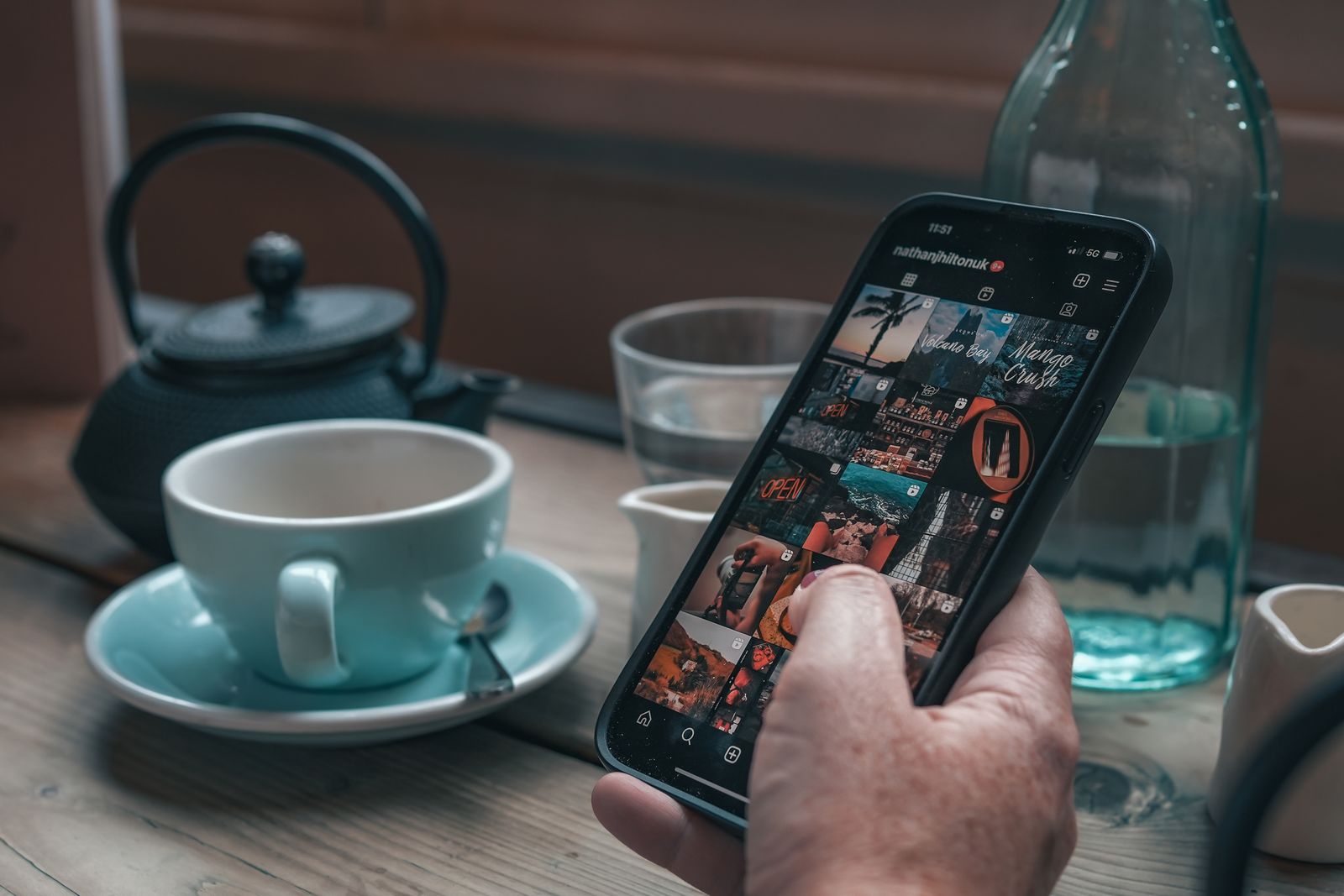
A feed is good at people. It is bad at addresses. Photo: Nathan J Hilton / Pexels.
A profile is not a unique URL you own
Your Instagram address looks like a URL. It is. It is theirs.
instagram.com/yourname is a page on a platform that can rename the product, change the rules, throttle reach, or disable the account. You do not control the HTML, the title Google sees, or whether the document exists next year. You cannot put a canonical on it. You cannot put it in your sitemap as a service you own.
A website you control has paths like /kitchen-fitting or /family-law on a host that is yours. Those paths can have titles that match the heading, copy a competitor cannot paste, and internal links a parser can follow. That is what I mean by unique URL. Not “unique content” as a slogan — a document with an address only you should own for that job in that place.
Instagram posts have links. They are Instagram’s links. They are not “emergency plumber Nottingham”. They are not something you can redirect when you rebrand. They are not something you can keep when the app decides your category is a problem.
The bio link is one slot. Every service, every location, every bit of proof is asked to share a single door, often a Linktree-style page that is another rented layer. A site can have many doors. Search can bookmark each one.
If you want the local version of what a Nottingham site actually has to do — one host, pages with addresses, a profile that matches — it is on website design in Nottingham and in what actually gets you found.
Search cannot find a Reel the way it finds a page
People discover local trades in two moods.
One is social. They already know you, or a friend sent a story, or they are bored on the tram and your tile looks good. Instagram is built for that mood. I am not going to talk it down.
The other mood is a query. Something broke. A date is fixed. They type the job and the town. Google — and the answer engines that fetch the same public web — look for documents. A document has a stable address, a title, and text that can be quoted. A Reel has a soundtrack.
You can be excellent on Instagram and invisible for the query that pays the month. The opposite is also true: a crawlable site with honest service pages will still want pictures of the work. The mistake is assuming the first thing is the second.
Nottingham makes this vivid because so much of the independent scene lives on Instagram first: studios, kitchens, salons, cafés, makers around the Lace Market, Hockley, Beeston, West Bridgford. The grid is the shop window. The window does not have a street number search can file. When a journalist, a supplier, or a customer who does not use the app tries to find “the official page”, they get a profile and a hope that the bio link works.
Case studies as grids have the same failure I already shipped and undid: pretty, and unciteable. The pattern I use for work is on proof — EO Charging is a path, not a modal. Your wedding florist proof should be a path too, even if the pictures also go on Instagram.
Trust is different on land you rent
A website is a claim you put your name on. Domain, company details, a contact path that works with JavaScript off, a Google Business Profile that points at the same host. That is a boring kind of trust. Boring is useful when someone is about to pay a deposit.
A profile is a feed of recent selves. It is good at showing faces and bad at showing terms. It is easy to look busy and hard to look accountable. Captions vanish under the next caption. Highlights are a filing system designed by a product team, not by your solicitor.
Platform risk is not theoretical. Accounts get locked. Categories get restricted. Paid reach becomes the only reach. None of that is a reason to delete the app. It is a reason not to store your only price list, your only booking path, and your only proof there.
Reviews on Instagram are not a substitute for a review you are allowed to point at, or a job write-up you own. Screenshots of five-star DMs are not crawlable proof. I will not invent review counts either. If you have the work, give it a page.
NAP honesty applies here too. If the profile, the site, and the Google listing disagree on the trading name, you look like three businesses. Missing a phone on the site is better than publishing a number nobody answers. I will not invent a street for schema to paper over a feed-only brand.
What Instagram is actually good for
I am not going to write a “kill your Instagram” piece. That would be a different kind of fake advice.
Instagram is good at:
- Showing the work as it happens, which a brochure page will never be.
- Letting regulars feel that a human is still there.
- Catching people who already know the area and are choosing with their eyes.
- Recruiting, suppliers, and press who live in the app.
It is bad at:
- Owning a query.
- Surviving a disabled account.
- Holding terms, accessibility, and a form that still works when the app is down.
- Giving each service a title and a canonical.
The split I recommend is dull. Instagram for people who already found you or were sent to you. Website for people who have not. The bio link should hit a page you own, not another profile. The site can embed or link to social; social should not be the only public document.
A café in Hockley can live on photos and still need a URL for hours, allergen notes, and hiring. A trades team can post every van job and still need /boiler-service if they want that phrase to mean them. A solicitor should not be asking a nervous client to “slide into DMs”.
What a Nottingham site has to do that a grid cannot
One honest host. www or apex, not both fighting, not a Linktree as the official website. Canonicals and the sitemap agree. That is in the found notes.
Pages with jobs. Homepage, one URL per service you want found, proof as pages, contact that works without JavaScript. Services is how I sell that work: a site that converts, then an app or automation if the business has outgrown forms.
Copy you can defend. The caption voice can stay on Instagram. The service page still needs a sentence only you would write.
A profile that matches. Google Business Profile website field should be the site, not the Instagram unless you truly have nothing else — and if you truly have nothing else, that is the gap.
Speed on a phone. The person who left Instagram to “check you are real” will not wait on a twenty-megabyte homepage. They already have a faster feed in the other tab.
You do not need a forty-page brochure to beat a grid. You need a handful of real documents.
A five-minute honesty pass
Open your Instagram. Count the services you actually sell. Now open the website — if it exists — and count the URLs that name those services. If the numbers are not in the same world, you have a feed.
Ask: if Instagram made the profile private tomorrow, what URL would a customer send to their spouse? If the answer is a Facebook page, you still do not have a site.
Ask: if Google could only keep one address, would it be yours? View source on the homepage. Can you find the town and the trade in the HTML, not in a widget that loads later?
If you want that pass run on a current domain, email me or book a slot. Bring the Instagram too if that is where the business actually lives. I will tell you which pages should exist, not how many times a week to post.
I will not sell you a content calendar as a substitute for URLs. I will not stuff “best in Nottingham” into a footer to compensate for a missing service page. I will not pretend a busy grid is an indexable business.
Bring the profile and the domain. I will tell you which one a stranger can actually find.